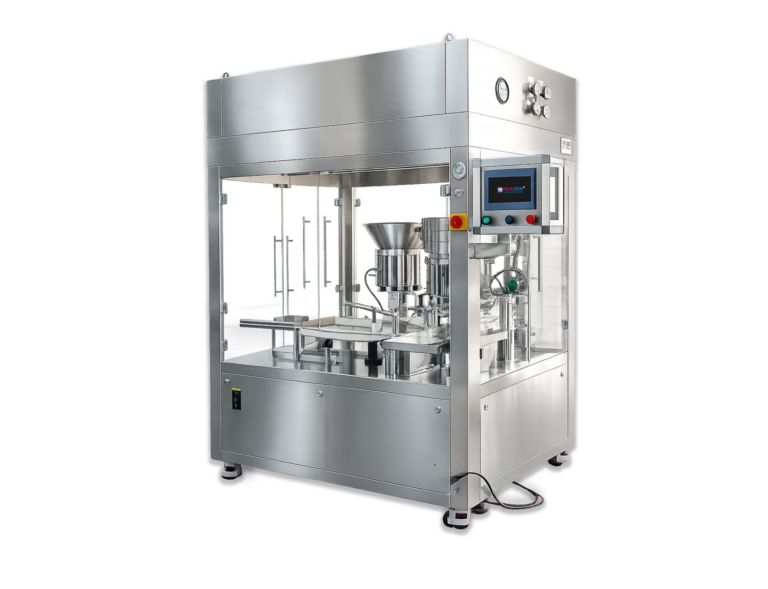
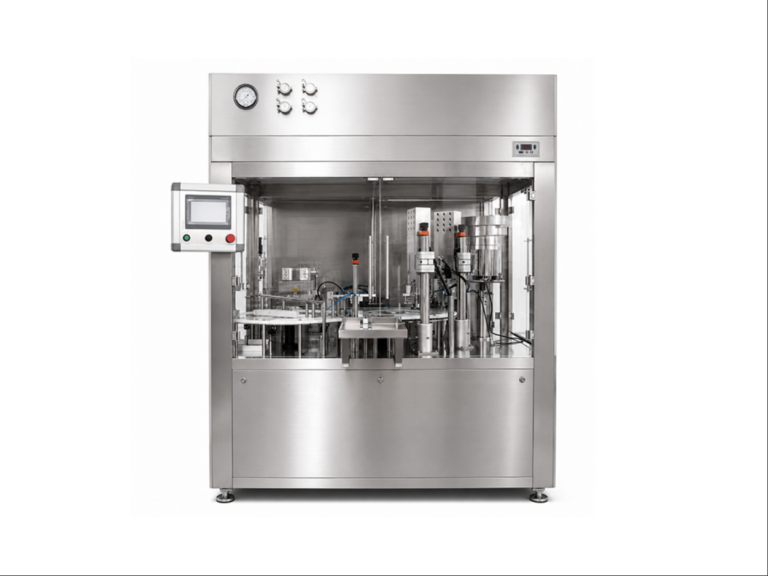
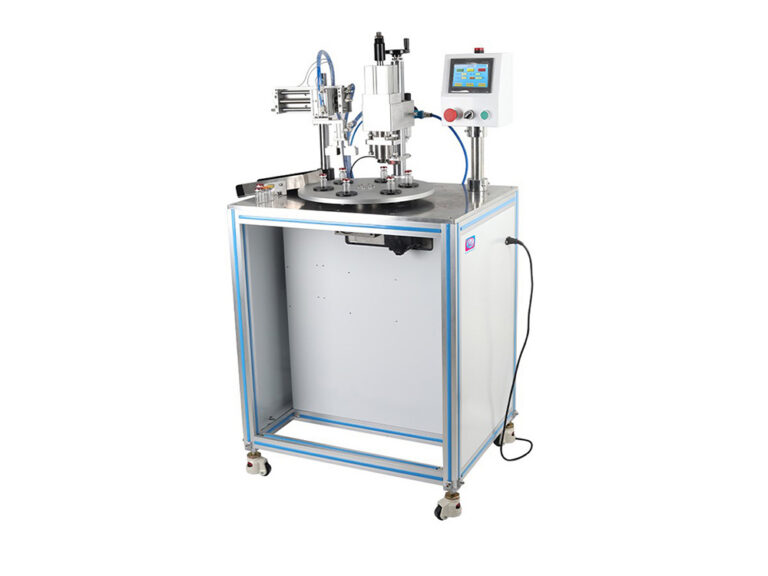
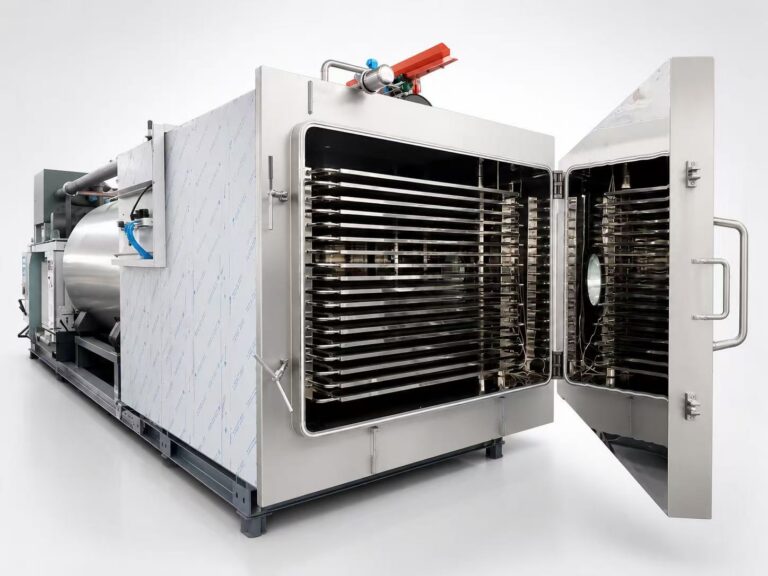
A continuous rotary system that integrates bottle sorting, dosing, stoppering, cap hanging and crimping into a single GMP-ready workstation. Built from 304 brushed stainless steel with multiple format-change parts for fast SKU switchover.
The RNE90350 is engineered for contract manufacturers and brand owners who need to switch between vial, bottle and cap combinations without re-tooling. Multiple format-change parts are supplied as standard, and the modular dosing head accepts peristaltic or rotary-piston modules depending on viscosity and fill-volume requirements.
Five-step rotary workflow — sorting, filling, stoppering, cap hanging, crimping — without manual transfer
High-speed configuration reaches 180–300 vials / minute for production-scale output
304 brushed stainless-steel enclosure, GMP-compliant surface finish and documentation
Optional laminar flow hood, CIP / SIP skid and LAF enclosure for aseptic applications
Compatible with multiple bottle, vial and cap types via dedicated change parts
Model
RNE90350
Process
Sorting → filling → stoppering → cap hanging → crimping
Speed (standard)
80 – 100 vials / minute
Speed (high-speed)
180 – 300 vials / minute
Filling Accuracy
± 3 – 5%
Standard Fill Volume
5 mL
Number of Heads
2 (modular head available)
Vial Height Range
27 – 50 mm
Body Material
304 brushed stainless steel
Power
220 V / 50 Hz · 3.5 kW
Optional Modules
Laminar flow hood, CIP/SIP, LAF enclosure
Compliance
GMP standard
Warranty
1 year for the whole machine
One line, five steps, zero hand-offs
One line, five steps, zero hand-offs
The RNE90350 rotary workstation integrates every step of the vial fill–finish workflow into a single continuous operation. No manual transfer, no break in the aseptic boundary — the line moves each vial through sorting, dosing, stoppering, cap hanging and crimping under one controlled environment.
1
Bottle sorting
Orients and feeds vials onto the rotary conveyor.
2
Filling
Servo-controlled peristaltic or rotary-piston dosing, ±3–5% accuracy.
3
Stoppering
Insertion of sterile rubber stoppers into the vial neck.
4
Cap hanging
Aluminum cap is hung on the stopper ready for crimping.
5
Crimping
Rotary crimping head seals the cap onto the vial.
Product description
The RNE90350 is engineered for contract manufacturers and brand owners who need to switch between vial, bottle and cap combinations without re-tooling. Multiple format-change parts are supplied as standard, and the modular dosing head accepts peristaltic or rotary-piston modules depending on viscosity and fill-volume requirements.
Five-step rotary workflow — sorting, filling, stoppering, cap hanging, crimping — without manual transfer
High-speed configuration reaches 180–300 vials / minute for production-scale output
304 brushed stainless-steel enclosure, GMP-compliant surface finish and documentation
Optional laminar flow hood, CIP / SIP skid and LAF enclosure for aseptic applications
Compatible with multiple bottle, vial and cap types via dedicated change parts
Please visit our FAQ page before reaching out to our customer support. Our team regularly updates this resource to provide you with the most up-to-date and comprehensive information, saving you valuable time.
Are your machines GMP-compliant?
All DIAGNOSEX process equipment is designed and manufactured in accordance with GMP / cGMP principles. Documentation packages supporting regulatory submissions — including material certificates, calibration records, and design qualifications — are available upon request.
Can the equipment be customized to our production line?
Yes. Vial and stopper formats, throughput, automation level, cleanroom classification, and integration with upstream or downstream equipment can all be tailored to your process. Share your requirements and our engineers will propose a configuration.
What is the typical lead time?
Standard configurations generally ship within 8–12 weeks after order confirmation. Customized or fully integrated lines typically require 12–16 weeks, depending on the scope of engineering involved.
Do you offer installation, commissioning, and operator training?
Yes. Our engineers provide on-site installation, commissioning, and structured operator and maintenance training. Remote commissioning support and English-language video training are also available.